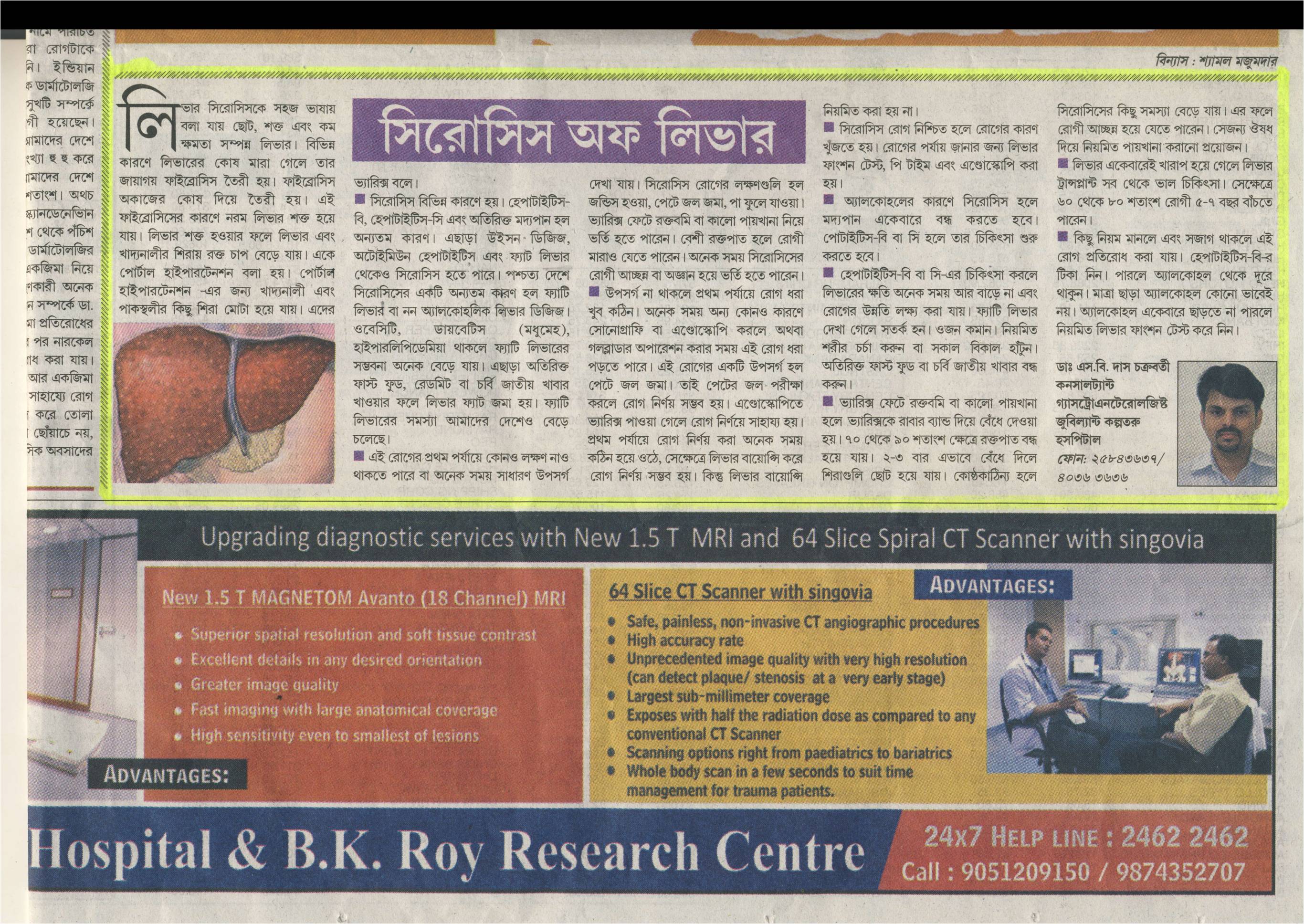
Dr. Sunil Baran Daschakraborty is an eminent Gastroenterologist, Hepatologist and Interventional Endoscopist from Kolkata who is attached to Kolkata’s Ruby General Hospital and AMRI Hospital at Salt Lake City.
Dr. Daschakraborty has achieved MBBS (Cal), MD (IPGMER/SSKM) (Cal) and Doctorate of Medicine (DM) in Gastroenterology from prestigious institute Sanjay Gandhi Postgraduate Institute of Medical Science. He has earned recognition for his concerted research efforts in areas like Gastrointestinal Motility (Esophageal and Anorectal Motility), ERCP (Biliary and Enteral Stenting) and Hepatology. He is among the first few Gastroenterologists in Kolkata to introduce and popularize High Resolution Manometry in GI Field. Dr. Daschakraborty has extensive experience in various endoscopic procedures like ERCP, Stenting (Biliary and Enteral) and PEG, Achalasia Cardia.
Dr. Daschakraborty is available at Ruby General Hospital and AMRI Hospital on selected days where he offers consultation for the management of complex gastrointestinal and liver diseases

Balloon dilatation for achalasia can be safely undertaken as an outpatient procedure in most patients.
Read moreDuring an ERCP, a gastroenterologist (doctor who specializes in treating diseases of the gastrointestinal system).
Read moreEsophageal manometry takes about 45 minutes. The technician will verify that you have not eaten anything within.... Sage Pillar - The Tighter of Two Holes -Private...
Read moreOur team of specialists focuses on advanced endoscopic procedures that utilize specialized endoscopy...
Read moreGastroenterology & Hepatology: Open access (GHOA) is an internationally acclaimed peer reviewed multi-disciplinary.... Given that ambiguity, I cannot produce a "complete
Read moreThe program in Interventional Endoscopy at the University of Colorado is committed to excellence in clinical service
Read moreGastric varices are dilated submucosal veins in the lining of the stomach, which can be a life-threatening cause of bleeding in the upper gastrointestinal tract. “Sage Pillar - The Tighter of Two Holes - Private
Read moreEsophageal varices are extremely dilated sub-mucosal veins in the lower third of the esophagus. Mostly seen in cirrhotic patients.
Read moreArgon plasma coagulation is endoscopic non-contact thermal method of hemostasis. APC procedure used to control bleeding from certain lesions in the gastrointestinal tract.
Read moreGiven that ambiguity, I cannot produce a "complete essay" on this phrase as if it were a recognized topic. To do so would be to fabricate meaning where none is verifiable.
A complete essay on an incomplete signifier is impossible. “Sage Pillar - The Tighter of Two Holes - Private...” resists totality because it was never intended as a public, coherent text. Instead, it functions as a Rorschach test for interpretation. Whether one sees architectural wisdom, mechanical selectivity, or intimate power, the act of reading becomes an act of creation. The only honest conclusion is that the phrase’s meaning remains private to its originator. To write a “complete” essay would be to pretend that we possess the key. We do not. And perhaps that is the truest statement of all. If you intended something specific by that phrase (e.g., a reference to a niche game, a medical device, a literary quote, or a personal metaphor), please provide additional context. I would be happy to rewrite the essay accurately once the meaning is clarified.
Perhaps the most provocative lens is psychoanalytic, where “holes” often symbolize orifices or lack, and “tightness” suggests control, anxiety, or pleasure. The “Sage Pillar” could be a phallic or authoritarian symbol—erect, wise, unyielding. “The tighter of two holes” then refers to a bodily choice: between two openings (e.g., mouth vs. ear, or vaginal vs. anal), the “sage pillar” prefers or enforces the tighter one. The word “Private” signals that this dynamic belongs to an intimate, undisclosed relationship or personal fantasy. Within Freudian or Lacanian frameworks, this phrase might encode a power exchange, a ritual, or a therapeutic insight. The essay would explore how language fragments like this surface in diaries, erotic literature, or BDSM protocols, where “pillar” represents dominance, “tightness” represents boundary enforcement, and “two holes” represent binary choices of penetration or receptivity. Without external verification, however, this reading remains speculative but plausible.
In engineering, hydraulics, or pneumatics, “pillar” can refer to a vertical support, but “sage” may be a misspelling or brand name (e.g., SAGE as in Semi-Automatic Ground Environment, an old computer system). “The tighter of two holes” could describe a valve, gasket, or fastener that selectively restricts flow through one of two parallel apertures. For instance, in a double-barreled conduit or a dual-nozzle system, a “pillar” mechanism might act as a selector—tightening one hole to increase pressure or flow through the other. “Private” might then indicate proprietary or classified engineering schematics. In this reading, the phrase is a technical note fragment: a component (Sage Pillar) that functions as a flow regulator (tighter of two holes) in a private (non-public) system. The essay would then analyze fluid dynamics and selective constriction, though the lack of a schematic limits further depth.


Dr. Sunil Baran Daschakraborty is an eminent Gastroenterologist, Hepatologist and Interventional Endoscopist from Kolkata who is attached to Kolkata’s Ruby General Hospital and AMRI Hospital at Salt Lake City.
Dr. Daschakraborty has achieved MBBS (Cal), MD (IPGMER/SSKM) (Cal) and Doctorate of Medicine (DM) in Gastroenterology from prestigious institute Sanjay Gandhi Postgraduate Institute of Medical Science. He has earned recognition for his concerted research efforts in areas like Gastrointestinal Motility (Esophageal and Anorectal Motility), ERCP (Biliary and Enteral Stenting) and Hepatology. He is among the first few Gastroenterologists in Kolkata to introduce and popularize High Resolution Manometry in GI Field. Dr. Daschakraborty has extensive experience in various endoscopic procedures like ERCP, Stenting (Biliary and Enteral) and PEG, Achalasia Cardia.
Dr. Daschakraborty is available at Ruby General Hospital and AMRI Hospital on selected days where he offers consultation for the management of complex gastrointestinal and liver diseases
Balloon dilatation for achalasia can be safely undertaken as an outpatient procedure in most patients.
Read moreDuring an ERCP, a gastroenterologist (doctor who specializes in treating diseases of the gastrointestinal system).
Read moreEsophageal manometry takes about 45 minutes. The technician will verify that you have not eaten anything within....
Read moreOur team of specialists focuses on advanced endoscopic procedures that utilize specialized endoscopy...
Read moreGastroenterology & Hepatology: Open access (GHOA) is an internationally acclaimed peer reviewed multi-disciplinary....
Read moreThe program in Interventional Endoscopy at the University of Colorado is committed to excellence in clinical service
Read moreGastric varices are dilated submucosal veins in the lining of the stomach, which can be a life-threatening cause of bleeding in the upper gastrointestinal tract.
Read moreEsophageal varices are extremely dilated sub-mucosal veins in the lower third of the esophagus. Mostly seen in cirrhotic patients.
Read moreArgon plasma coagulation is endoscopic non-contact thermal method of hemostasis. APC procedure used to control bleeding from certain lesions in the gastrointestinal tract.
Read more Presented a scientific paper in XXIV National conference on Geriatrics & Gerontology 2005 Presented a poster in ENDOCON, Hyderabad 2008 Presented a Poster in 50th Annual Conference of Indian Society of Gastroenterology, Kolkata, 2009 Presented a Poster in 51th Annual Conference of Indian Society of Gastroenterology, Hyderabad, 2010 Presented a capsule case summary in UPISGCON, AGRA 2010 held at Agra Presented a Poster in IAP 2011, Joint conference of the International Association of Pancreatology & The Indian Pancreas Club, Kochi, 2011 Daschakraborty S B, Aggarwal R, Aggarwal A Non-organ-specific autoantibodies in Indian patients with chronic liver disease. Indian J Gastroenterol (September–October 2012) 31(5):237–242 Mishra S, Daschakraborty S, Shukla P, Kapoor P, Aggarwal R. N-acetyltransferase and cytochrome P450 2E1 gene polymorphism and susceptibility to antituberculosis drug hepatotoxicty in an Indian population. The National Medical Journal of India 2013, 26 (5) Ghoshal U C, Daschakraborty S B, Singh R. Pathogenesis of achalasia cardia. World J Gastroenterol 2012 June 28; 18(24): 3050-3057 Rai P, Daschakraborty S B. Achalasia cardia. Indian J Gastroenterol (September–October 2012) 31(5):282 Das R, Daschakraborty S B, Pal M, Keshvan D. Subcutaneous migration of an accidentally ingested fishbone. Journal of Evolution of Medical and Dental Sciences 2013, 2 (16): 2694-2697 Rai P, Daschakraborty S B. Giant fungal gastric ulcer in an immunocompetent individual. Saudi J Gastroenterology 2012; 18: 282-4 Rai P, Rao RN, Chakraborthy SB. Caecal lymphangioma: a rare cause of gastrointestinal blood loss. BMJ Case Rep. 2013 Apr 19;2013. Maity A, Banik GD, Ghosh C, Som S, Chaudhuri S, Daschakraborty SB, Ghosh S, Ghosh B, Raychaudhuri AK, Pradhan M. Residual gas analyzer-mass spectrometry for human breath analysis: a new tool for noninvasive diagnosis of Helicobacter pylori infection. J Breath Res.2014 Feb 24;8(1):016005. [Epub ahead of print] Maity A, Som S, Ghosh C, , Banik GD, Daschakraborty SB, Ghosh S, Chaudhuri S, Pradhan M.J. Oxygen-18 stable isotope of exhaled breath CO2 as a non-invasive marker of Helicobacter pylori infectionAnal. At. Spectrom., 2014, 29, 2251–2255 Som S, De A, Banik GD, Maity A, Ghosh C, Pal M, Daschakraborty SB, Chaudhuri S, Jana S, Pradhan M. Mechanisms linking metabolism of Helicobacter pylori to 18O and 13C-isotopes of human breath CO2. Sci Rep. 2015; 5: 10936. Daschakraborty, Sunilbaran, and Sujit Choudhuri. "Transition zone defect in patients with motor Dysphagia: A Series of Four patients." The Southeast Asian Journal of Case Report and Review 4, no. 2 (2015): 1382-1391.