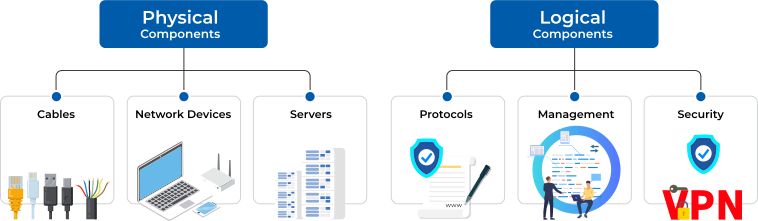
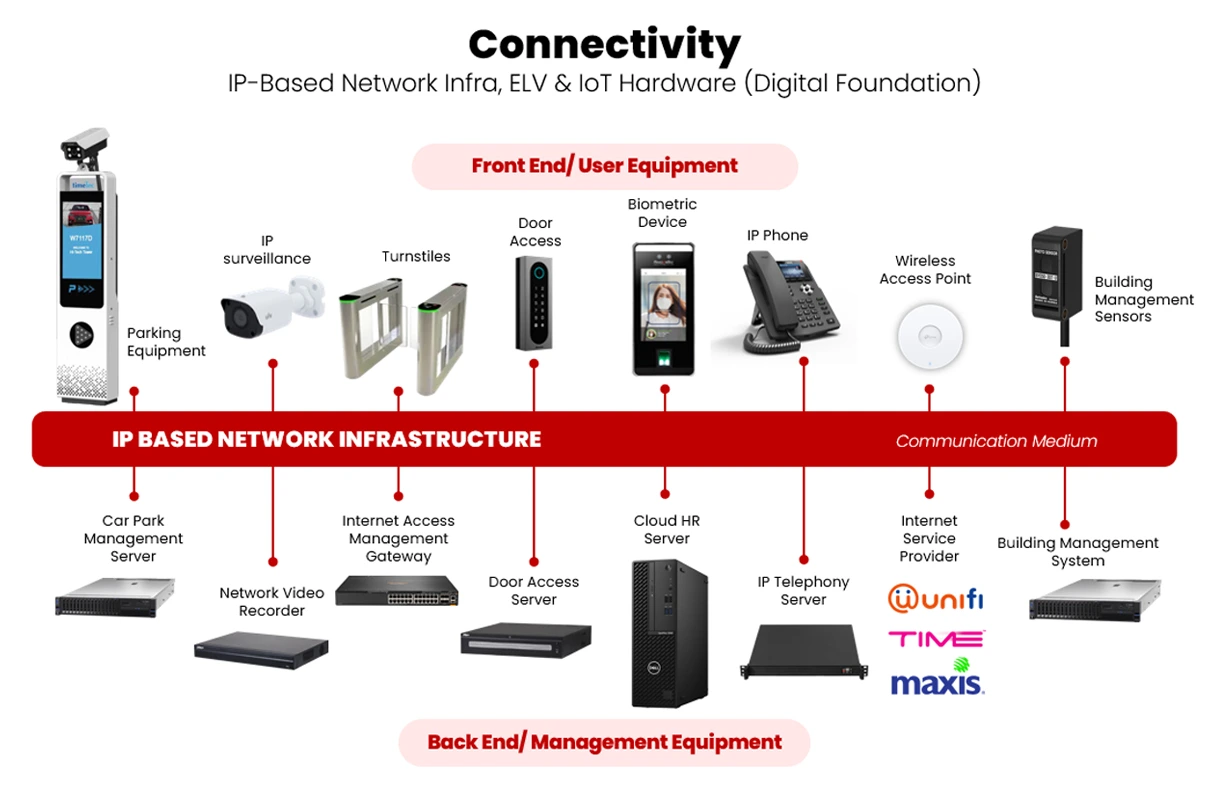
TimeTec offers complete Network Infrastructure solutions alongside our comprehensive PropTech ecosystem, delivering seamless connectivity to support smart building operations. From structured cabling to high-performance network equipment, our infrastructure services are designed to integrate flawlessly with TimeTec’s PropTech solutions—including smart access and elevator control, ELV & IoT automation, smart cashless and touchless parking, visitor management and etc., ensuring a reliable, scalable, and future-ready environment for modern commercial and residential buildings.
What Is a Well-Designed Network Infrastructure?
A well-designed network infrastructure is essential for any organization that relies on technology to operate effectively. It provides the foundation for integrating emerging technologies and new applications, allowing businesses to remain agile, up-to-date, and competitive in their industries.
For service providers, building a robust network infrastructure means ensuring scalability, high availability, and intelligent load balancing. These elements are critical to maintaining seamless connectivity and reliable system performance—key factors in today’s fast-paced digital environment.
Since network interruptions can never be entirely avoided, it's also vital to adopt streamlined network architectures and automated management tools. These help network administrators quickly identify, isolate, and resolve issues, minimizing downtime and ensuring optimal network functionality.
And for the first time in years, you feel free.
The message is also a riddle. Opus means “work.” License means “freedom” (from licere , “to be allowed”). So the alert reads: Perhaps that’s the real error. Not a missing code, but a missing relationship between creator and tool. The software waits for permission from a machine that no longer answers. Meanwhile, the only true license — the one that lets you sit down and make something from nothing — was never in the EULA. It was in your hands all along.
Below is a short, reflective piece capturing the frustration, mystery, and strange poetry of that notification. You sit down to work. The project is half-finished, the deadline close. You double-click the icon for Opus — whatever version of Opus lives on this machine: an audio workstation, a suite, an old piece of creative software whose name once meant masterpiece .
Instead of the familiar loading screen, a cold gray dialog box appears: No license. Not expired . Not invalid . Just — absent. As if the permission to create has been revoked by some silent authority in the cloud. You check your email. No renewal notice. You check the system registry, the license folder, the dusty filing cabinet where you once kept a printout of an activation key. Nothing.
And you realize: you don’t own it. You never did. You were only ever borrowing a ghost.
Opus There Is No License For This Product Access
And for the first time in years, you feel free.
The message is also a riddle. Opus means “work.” License means “freedom” (from licere , “to be allowed”). So the alert reads: Perhaps that’s the real error. Not a missing code, but a missing relationship between creator and tool. The software waits for permission from a machine that no longer answers. Meanwhile, the only true license — the one that lets you sit down and make something from nothing — was never in the EULA. It was in your hands all along. opus there is no license for this product
Below is a short, reflective piece capturing the frustration, mystery, and strange poetry of that notification. You sit down to work. The project is half-finished, the deadline close. You double-click the icon for Opus — whatever version of Opus lives on this machine: an audio workstation, a suite, an old piece of creative software whose name once meant masterpiece . And for the first time in years, you feel free
Instead of the familiar loading screen, a cold gray dialog box appears: No license. Not expired . Not invalid . Just — absent. As if the permission to create has been revoked by some silent authority in the cloud. You check your email. No renewal notice. You check the system registry, the license folder, the dusty filing cabinet where you once kept a printout of an activation key. Nothing. So the alert reads: Perhaps that’s the real error
And you realize: you don’t own it. You never did. You were only ever borrowing a ghost.