
Visual Audio Splitter & Joiner
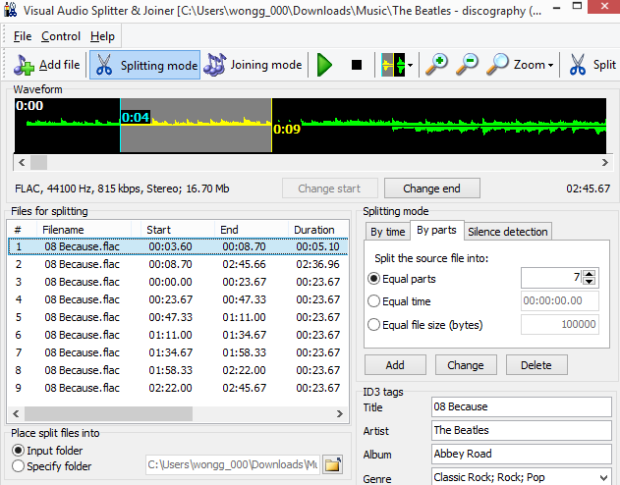
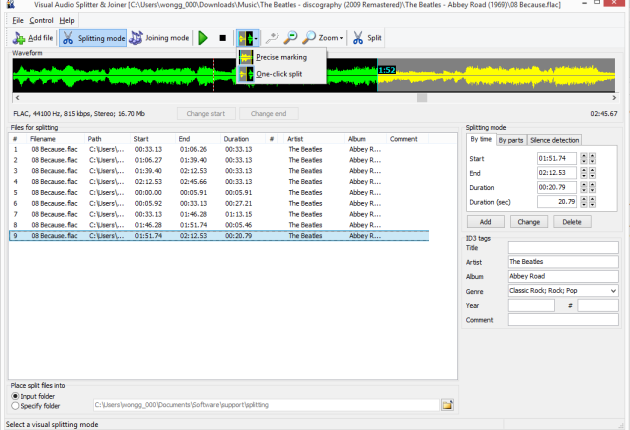
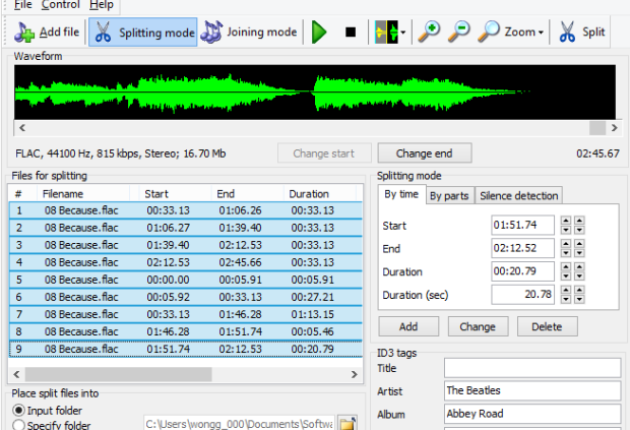
A handy software utility that can split and combine audio files. Cut files fast and easy using the waveform without losses in quality.


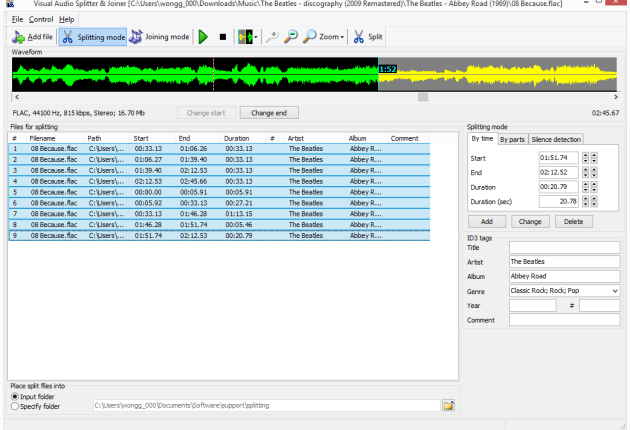
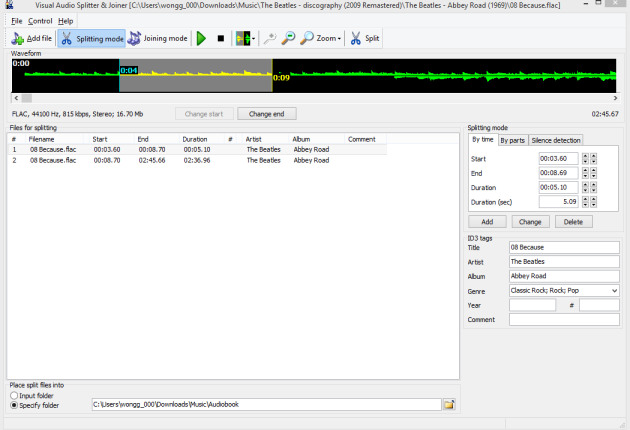
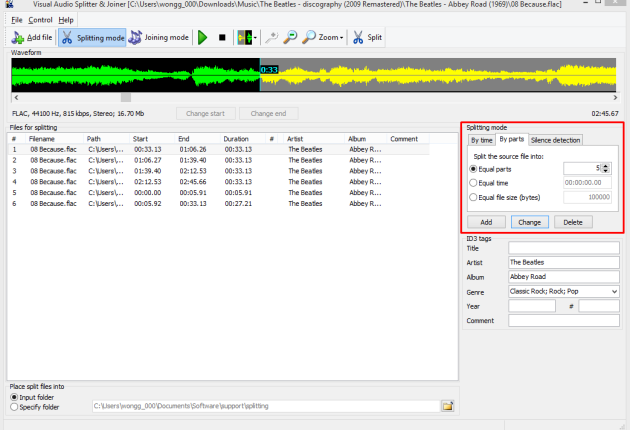
Split MP3, WMA, APE, and WAV files by a number of equal parts, by size, by duration. All the supported formats are split directly, without conversion!




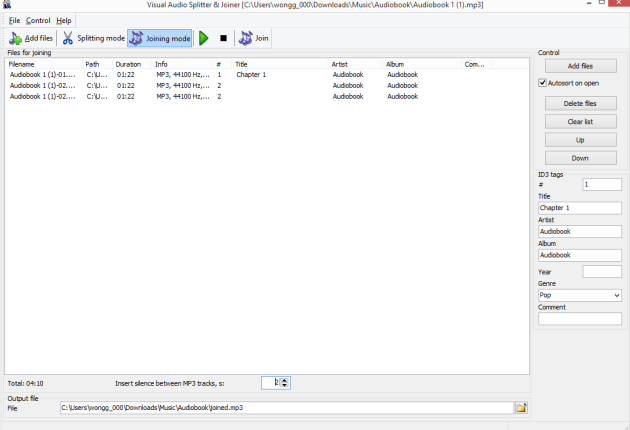
Visual Audio Splitter & Joiner allows you not only to split multiple audio files at once but also in any order. Join MP3, APE, WMA, and WAV files in any succession. Note that only parts in the same format can be merged. So if you want to merge files in different formats, you can convert them to the desired output format with AudioConverter Studio.

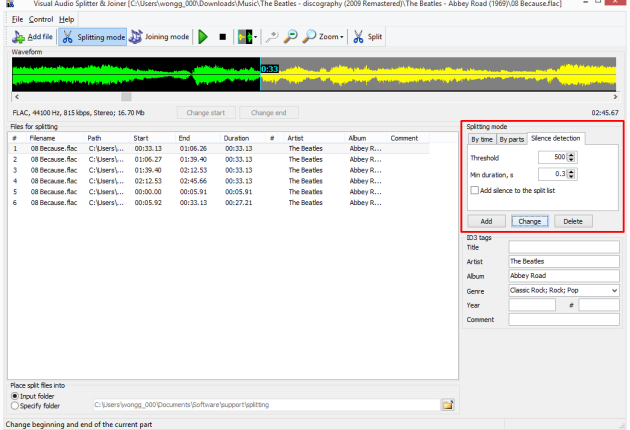
Suppose that you have an album of your favorite band in a single file and want to get easy access to each song. Visual Audio Splitter & Joiner is the right tool for this. In just a few seconds it will detect pauses between songs using the silence detection feature. All you need to do is to click the “Split” button. The MP3 splitter will deliver the result in virtually no time.

CUE files can be also used with media players. Nowadays many media players support CUE sheets either by using plugins or by initial design. CUE sheet is a simple text file (in ASCII encoding) which contains information concerning how audio tracks should be laid out on a CD.
Visual Audio Splitter & Joiner will help you create CUE sheets that will retain the detailed information. In this case, you don’t actually split the file but merely save the information about its parts into a CUE file.


Visual Audio Splitter & Joiner is so fast that you might ask: “Is it good for my files?”. The funny thing is, however, that Visual Audio Splitter & Joiner has absolutely no impact on quality.
In conclusion, the “AirDrop Enabler iOS 7.0 download” is a linguistic artifact of technological grief. It represents the impossible wish to keep legacy hardware competitive in a contemporary connectivity landscape. The practical answer is harsh but necessary: no such enabler exists, and even if a hacker produced a proof-of-concept, running it on an iOS 7 device would be the equivalent of building a new front door on a house whose walls are collapsing. Users facing this dilemma have only two rational paths: accept the device’s stock limitations (using iCloud Drive or email as workarounds) or retire the device entirely. The search for a phantom download is not innovation—it is an echo in an abandoned software library, reminding us that in technology, as in life, you cannot force new functions onto old foundations without breaking both.
Furthermore, the search itself fuels a parasitic economy of scam websites and fake “tweaks.” A typical result for “AirDrop Enabler iOS 7.0 download” leads to shady forums, survey scams, or links to jailbreak repositories that have been abandoned for a decade. Even within the jailbreak community—where legitimate tweaks like AirDrop Enabler (for older iOS 6 devices) once existed—no stable, functional version for iOS 7 has ever been verified. The absence of credible GitHub repositories or discussions on r/jailbreak confirms that this is largely a myth propagated by clickbait article generators. Users who ignore this reality risk installing software that steals contacts, hijacks SMS, or enrolls the device in a botnet. airdrop enabler ios 7.0 download
The persistence of this search query, years after iOS 7 was superseded, points to a romanticized view of older operating systems. Users often cling to iOS 7 because it is the last “skeuomorphic-free” version that runs smoothly on aging hardware like the iPhone 4 or the original iPad mini. They seek to bridge the gap between a stable, responsive OS and modern functionality. Yet, this desire blinds them to the security nightmare that is any unsupported OS. Since Apple stopped signing iOS 7 and issuing security patches, any third-party “enabler” downloaded from a non-official repository would operate with root-level privileges on an OS riddled with known vulnerabilities (e.g., the “goto fail” SSL bug). The act of seeking such a download is not digital archaeology; it is digital self-harm. In conclusion, the “AirDrop Enabler iOS 7
In the digital ecosystem, few phrases evoke a stronger sense of technological purgatory than a search for an “AirDrop Enabler iOS 7.0 download.” At first glance, this query appears to be a straightforward request for a utility—a missing link, a software patch, or a jailbreak tweak that would grant an older iPhone or iPad the modern convenience of Apple’s wireless file-sharing protocol. However, a deeper examination reveals that this phrase is not a solution but a symptom: a testament to planned obsolescence, the fragmentation of legacy mobile operating systems, and the dangerous nostalgia for unsupported software. Users facing this dilemma have only two rational
To understand the futility of the search, one must first recognize a fundamental hardware and software incompatibility. Officially, AirDrop was introduced to iOS devices with the iPhone 5 and later, running iOS 7. However, the feature was not a universal software toggle that could be retroactively “enabled” on any iOS 7 device. AirDrop on iOS 7 relied on specific low-power Bluetooth 4.0 hardware (Bluetooth LE) and a dedicated Apple-designed networking chip for peer-to-peer Wi-Fi. Devices like the iPhone 4S, which can run iOS 7, were explicitly excluded from AirDrop support not because Apple forgot to include a software switch, but because the necessary silicon was physically absent. Consequently, any file or tweak promising an “AirDrop Enabler” for such devices is, by definition, a hoax, a malware vector, or a fundamental misunderstanding of hardware abstraction.